Head-and-Shoulders Targets: Check the Arithmetic
A price-pattern target can become impossible when a point move is copied blindly from one price level to another.
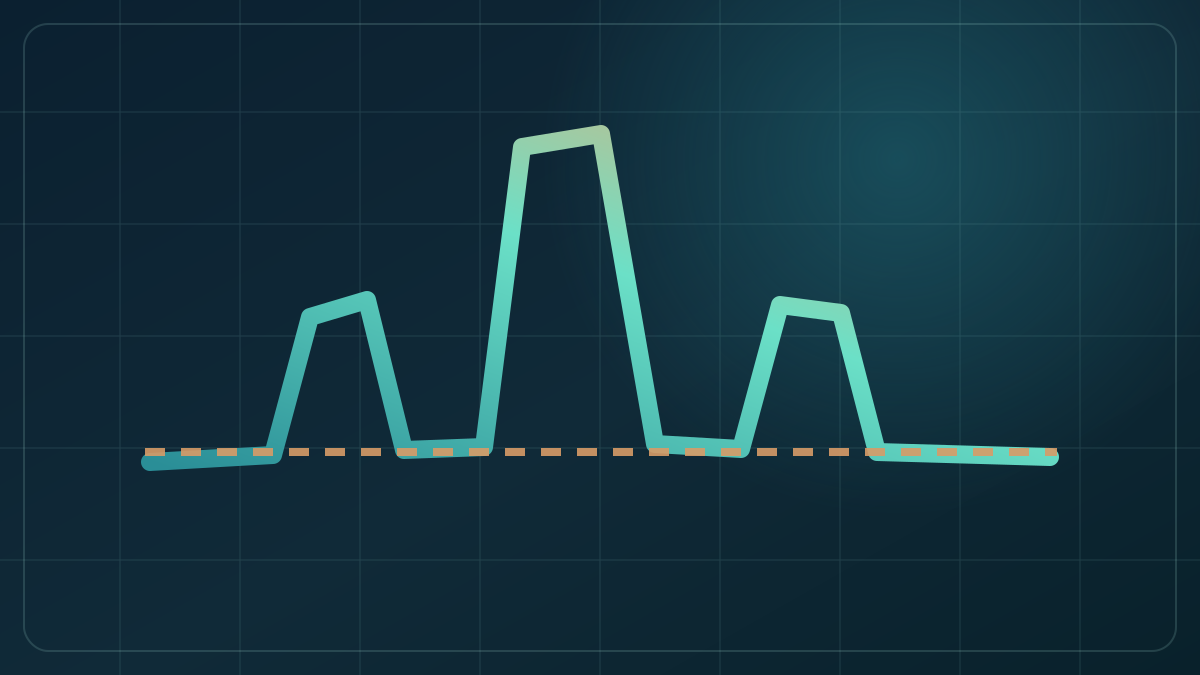
The central lesson is mathematical. A measured move from a head-and-shoulders pattern is a planning convention, not a price prediction. Before placing a target, check whether the chosen measurement even makes sense at the breakout price.
Points can produce nonsense
Consider an illustrative stock that falls from about $16 at the head to a $5 neckline: an $11 height. Subtracting $11 from a later break near $5 would imply a negative share price. That target is impossible for an ordinary share. The arithmetic should stop the analyst before the trade starts.
A percentage is one alternative
The decline from $16 to $5 is $11 divided by $16, or 68.75%. Applying the same percentage to a $5 break gives an illustrative target near $1.56. The transcript rounds that to 70% and $1.50. The percentage method avoids a negative price, but it does not make the target likely.
Either method changes the scale of the assumption. The point method asks for another $11 decline; the percentage method asks for another 68.75% decline. Those are not interchangeable forecasts. In other charts, the point method may be feasible and the percentage method may still be too aggressive.
Separate the target from the risk plan
Mark the neckline, invalidation level and position size before considering either target. Then test the exact rule on a full sample of similar setups, including false breaks. A measured move can organise an exit plan; it cannot establish an edge by itself.
Sources and notes
This article is general educational information, not personal financial advice or a recommendation to trade. Examples and chart patterns do not predict future returns. Investing and trading involve risk, including loss of capital.
Explore more Methodical Edge articles.
Browse Methodical Edge →